
What is the Role of Ligand Density for Separation?
When meeting with potential bulk silica customers for the first time, we are often asked the following question: “Do you have an ODS/C18 phase?”
While the answer is, of course, a resounding yes, we also suggest that this is not the right question to be asking your silica gel supplier!
The right question is: “What different ligand densities do you offer for your ODS/C18 phases?”
With ligand density (sometimes called bonding density), we express how much of the given ligand is grafted onto the silica’s surface – not only onto the outer particle surface, but also on the INSIDE of the silica particle (within the walls of the pores). The intensity of the silica surface’s chemical modification is characterized by this total ligand density. Higher ligand density isn’t always better – it depends on the application. DAISOGEL offers ODS products with a range of ligand densities, giving you different levers to pull in your purification development
For example, if we produce an ODS with a relatively small number of ligands, then we end up with a low bonding density phase. This phase will exhibit low hydrophobicity and short retention time, but a limited pH range.
High bonding density ODS phases have a higher carbon loading and feature wide pH ranges and longer retention times. They are a great choice when the target molecule can only be kept in solution on aggressively low or high pH conditions.
Ligand Densities and Properties of DAISOGEL ODS Phases
Product Name
C%
pH Range
Hydrophobicity
Feature
Retention
SP-120-x-ODS-BP
Low 15%
1.5 – 9.0
Low
aqueous: 100% water compatible

SP-120-x-ODS-RPS
Average 17%
1.5 – 9.5
Middle
universal: wide application range

SP-120-x-ODS-BIO
High 20%
1.0 – 10.5
High
durable: wide
pH range

In reality, the same C18 ligands on the same silica behave quite differently in chromatography applications, depending on the ligand density. See the differences in separation below when an ODS with low, average, and high ligand density is utilized.
Tanaka Test
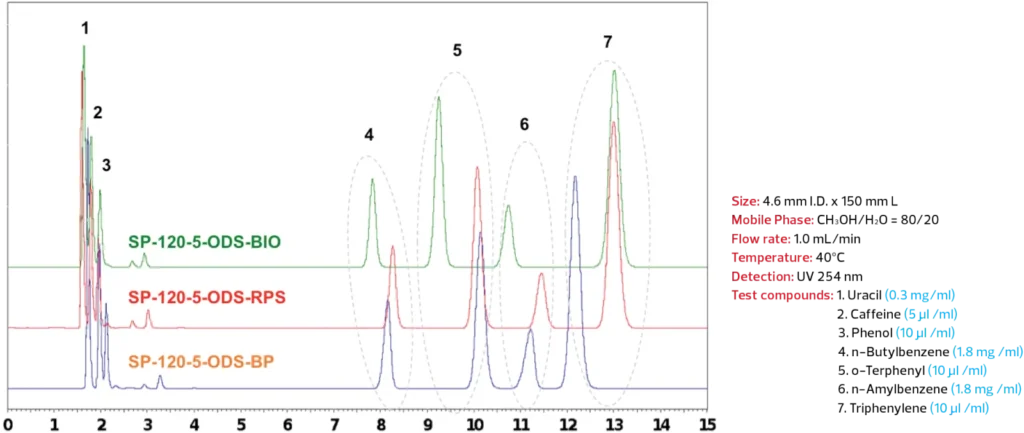
Ligand Density Impact on Selectivity
Product Name
Ligand
Density
k2/k3
(Hydrogen Bonding)
k6/k4
(Hydrophobicity)
k7/k5
(Steric Selectivity)
SP-120-5-ODS-BP
Low
0.62
1.48
1.24
SP-120-5-ODS-RPS
Average
0.53
1.48
1.37
SP-120-5-ODS-BIO
High
0.45
1.47
1.49
Contact us to learn more
Next time you are speaking with your silica gel supplier about their ODS products, make sure to ask about the ligand density. Or reach out to DAISOGEL and we’ll help you choose an ODS with the ligand density that’s right for your application.