
PRODUCTS
COMPASS KIT
Concept
Choosing the right stationary phase for your large-scale peptide purification process is a crucial decision. It impacts not only the economics of the purification step, but the overall feasibility of your entire API manufacturing process.
With probably dozens or even hundreds of scouting columns available in your laboratory, the options can be overwhelming. Extensive column screening simply costs too much time and resources.
The Chromatography Compass Kit is a science-based shortcut to identifying the optimal silica phase. Just as a traditional compass guides you toward your destination, our kit points you directly to the right separation mode.
Where is the SCIENCE?
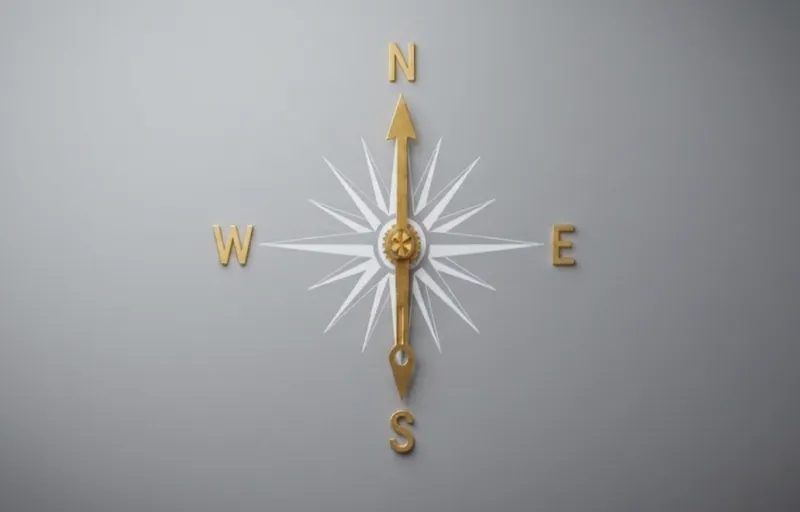
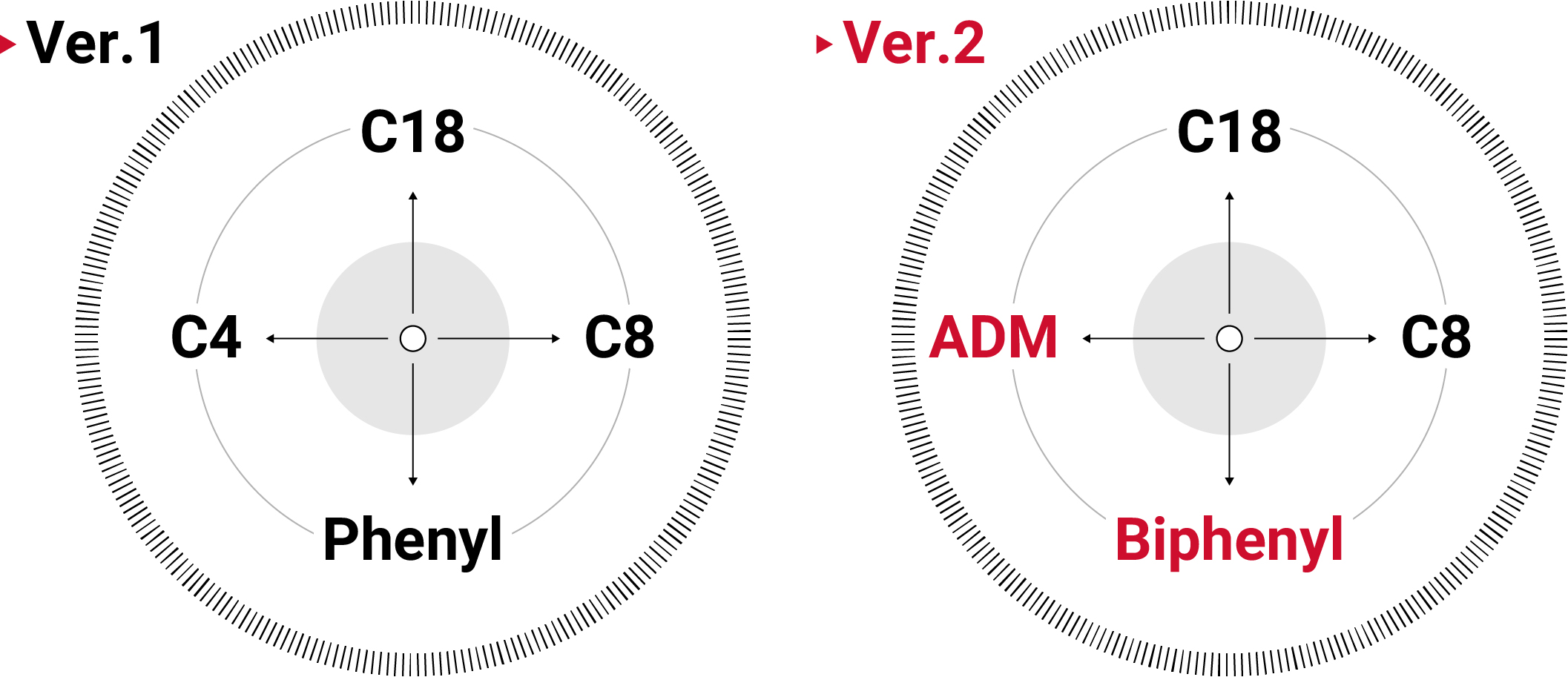
The 4 directions in the Chromatography Compass represent 4 different separation modes:
NORTH
Pure hydrophobic interaction
EAST
Mainly hydrophobic interaction with secondary interaction
SOUTH
π-π interaction
WEST
Tightly controlled silanol interaction
In our standard Chromatography Compass Kit, four distinct separation modes are represented by four pre-packed analytical columns containing preparative-grade silica. We include the SP-100-10-ODS-P for pure hydrophobic interaction, and the SP-100-10-C8-PK to represent hydrophobic interaction with secondary silica surface interactions. For π-π interactions, the choice falls on SP-100-10-Ph-HP, while the SP-100-10-C4-NP (non-endcapped) is used to demonstrate silanol interactions.
In the new Chromatography Compass Kit Version 2.0, we have updated two of these columns. Pointing South, the π-π interaction is now represented by the stronger SP-100-10-BiPh-HP (biphenyl). Pointing West, silanol interactions are demonstrated by our unique SP-100-10-ADM-HP (adamantyl-bonded silica with tightly controlled, preserved silanol activity).
If you are working with limited crude sample or need faster screening times, the Rapid Compass Kit is also available.
How to use the COMPASS KIT?
The process is straightforward:
- Take the four columns from the kit and run a quick scouting injection on each.
- Evaluate which separation mode provides the best resolution between your target compound and key impurities.
- Optionally, screen additional columns within that same mode (e.g. other phenyl-based phases if C4Ph/BiPh was a hit) to further fine-tune your method.
That’s it ! You have scientifically identified the optimal stationary phase for your large-scale peptide purification.
COMPASS Examples
Nucleoside separation
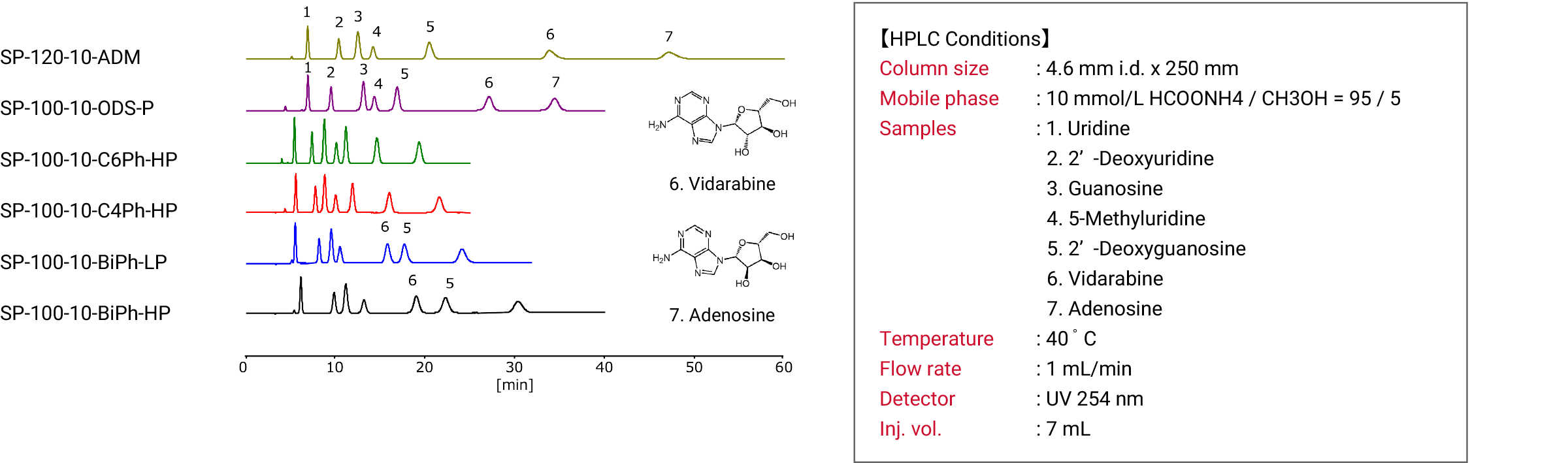
The elution order of the ADM column is the same as ODS column, but the retention time is longer, confirming the interaction with the high surface polarity of ADM. In particular, adenosine (7.) and its analog (6.) are retained for a long time, confirming their interaction with the high surface polarity of the ADM.
Peptide separation
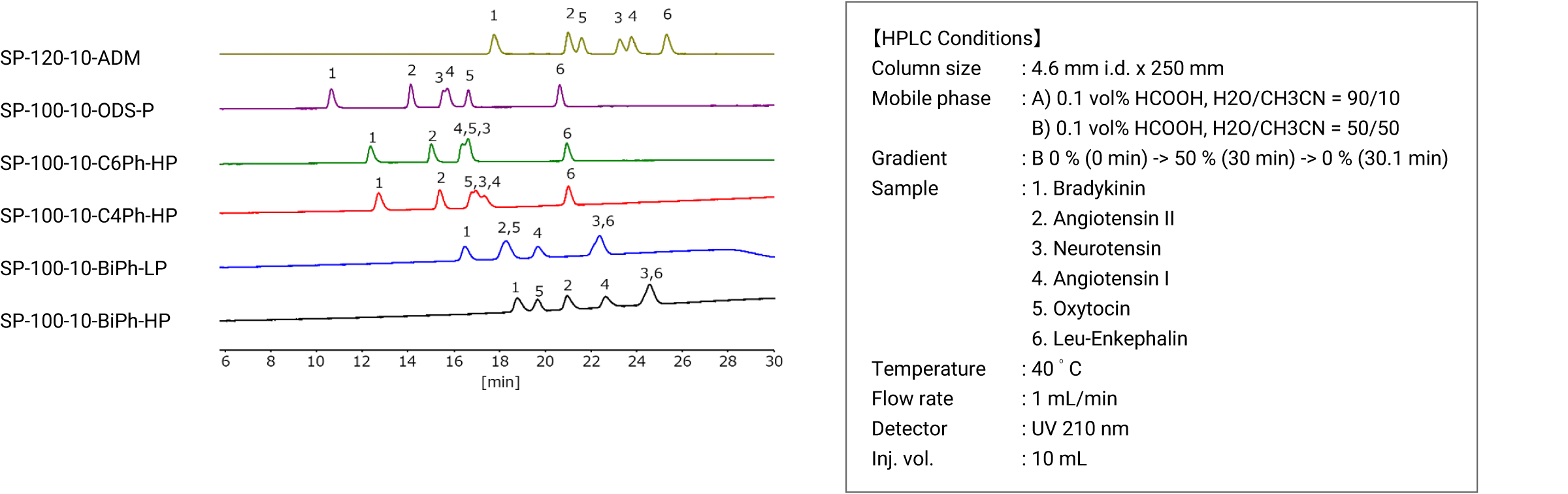
On the ODS and phenyl columns, the retention times of neurotensin (3.) and angiotensin I (4.) overlap, making separation impossible. On the other hand, on the ADM column, a single peak was observed for all peptide samples, providing the best separation.
Aromatic compound isomer separation
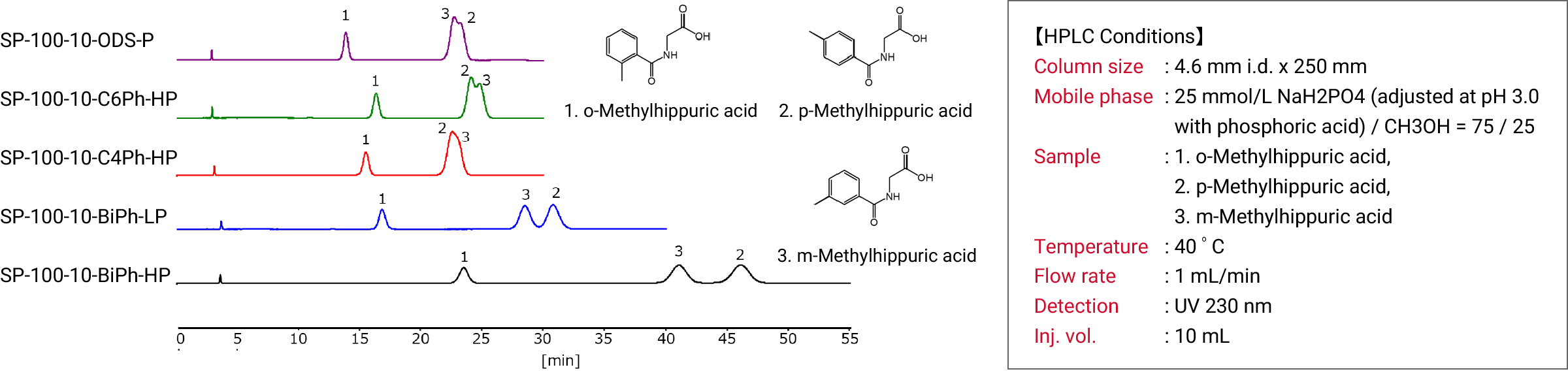
Separation of aromatic isomers is difficult with ODS columns and phenyl columns, but the biphenyl column showed the best separation. In addition, a higher biphenyl modification density showed in stronger interactions and longer retention, resulting in better separation.